The Greek roots of the word photography translate as "writing with light." Welcome to my studio--a place to practice and illuminate good work using writing and photography.
Showing posts with label South Africa. Show all posts

Wednesday, May 27, 2020

Never underestimate weird warthogs

Visitors to South Africa soon become bored with warthog sightings. They aren't much to look at, and they appear at every turn on the safari. But warthogs are very strong, extremely smart animals. Unlike many others, they are not endangered because they are skilled at adapting to new threats. Take for example that they are crepuscular (feed early morning and evening). But if they live in an area where they are hunted by people, they switch to foraging at night.

Oddball hornbill

If this bird looks familiar, you likely remember Zuzu from The Lion King. If you didn't know, Zuzu was a yellow-billed hornbill. Hornbills are common in Kruger National Park and elsewhere in South Africa. They are omnivores that eat insects, bird chicks, frogs, chameleons, ants, termites and occasionally fruit. Seeing them is a thrill because they are so unique, and they have interesting habits worth mentioning.

Tuesday, May 26, 2020

Magical mousebirds

"In the trees to the right, see the mousebirds?" asks our guide as he makes a quick stop alongside the dirt road in Addo Elephant Park in South Africa. "They only live here." We strain to make out what and where he is pointing, but see only light-speed movement of the small flock away from the road into the trees. It is the first of three attempts to introduce us as they scurry off like a band of mice. In the day use area where we stop to have a late breakfast, it is a different story. Like many of the common birds here, their docile cousins survive by scrounging on the remnants of visitors, and warily pose for pictures.

Sunday, May 24, 2020

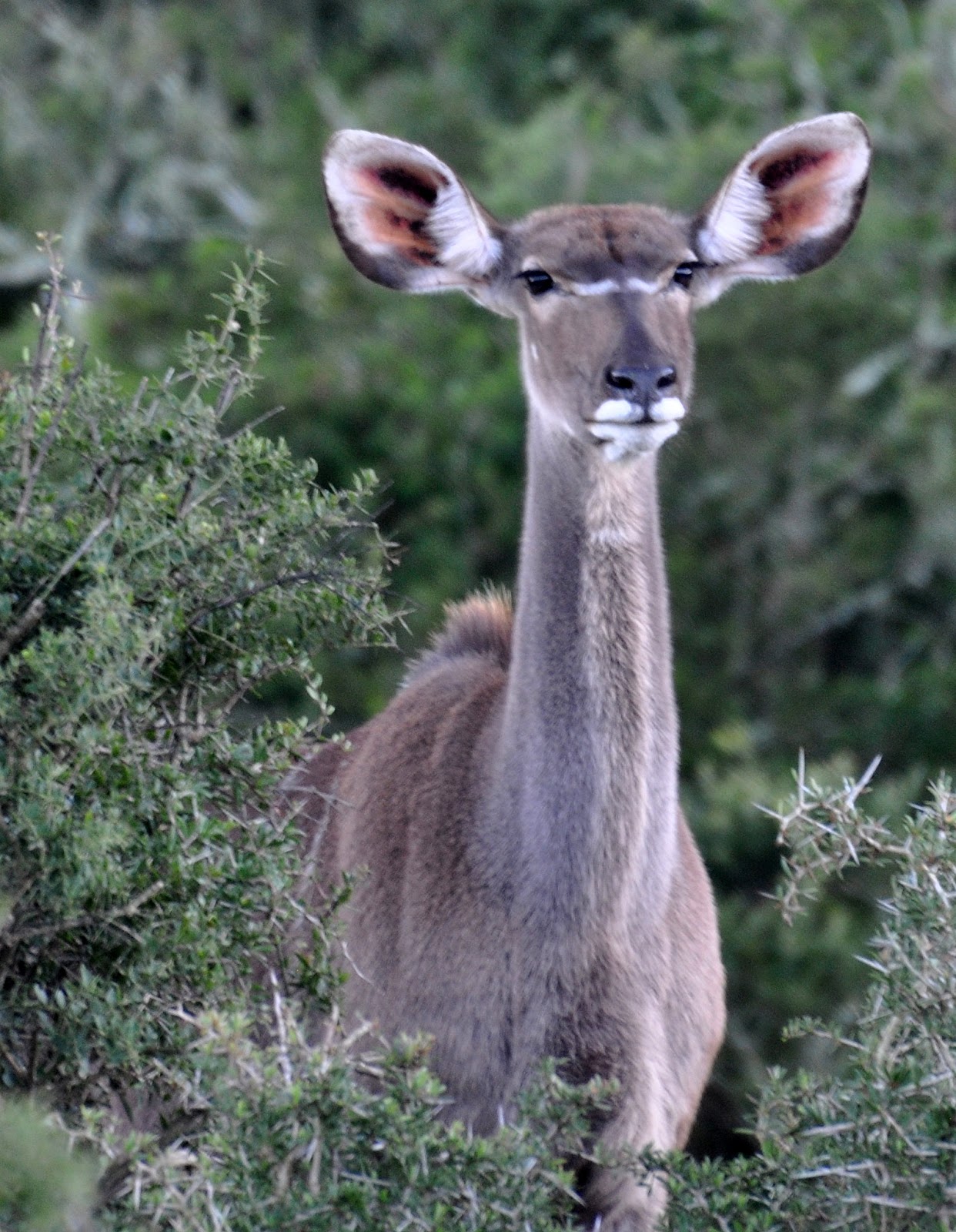
Two-faced kudu

It is our first morning in Addo Elephant Park in South Africa. The morning is motionless and clear, notably quiet, cold and still dark as we load our guide's extended cab pick-up. We are here at the beginning of winter season because of the reduced chance of running into mosquitoes and malaria. Though we enjoy a short drive the evening before, this is our first full day in the truck looking for wildlife. The heater is running in the front seat while I take over the back with camera and gear. Sunrise comes quickly as we drive the road from Matyholweni Camp to Addo Main Camp in the north. By the time we reach Harvey's Loop the light is perfect. We are the only vehicle on the road, which is a blessing when we come around the corner to encounter a small herd of kudu.
Our guide skillfully coasts next to the group of eight as we hold our breath, hoping not to startle these hard to approach antelope. Their radar-like ears easily detect danger, causing them to bark and flee. Instead, they raise their heads and stare. We sit for several minutes and stare back, overwhelmed by the sheer mass of the herd, how exquisite their markings and their quiet stillness. It's not until I have looked at them for several minutes that I notice that each one of them has a mustachioed face on the end of their muzzle.

Saturday, May 23, 2020

Tribal meerkats

There are few animals that work as well together as meerkats. These squirrel-size members of the mongoose family live in groups of different sizes, from as little as three to as many as 50. Together they build up to five separate burrows with multiple entrances, tunnels, and rooms.

Friday, May 22, 2020

Formidable ostrich

It isn't that you are the biggest bird, look through the biggest eyes, lay the biggest eggs, run faster than any other two-legged creature, nor that you can kill a human or predator by kicking with your clawed foot, or use sand and pebbles (instead of teeth) to help you digest your food. What blows me away is that you are all that, and can still occasionally do ballet.

What's that sound?

Although it was previously believed that giraffes were either completely silent or made noises that humans were unable to hear, a 2015 study at the University of Vienna reported that giraffes hum at night—and humans can hear it. Researchers hypothesize that humming is an attempt to keep their herd together when their vision is impaired by low light.

Thursday, May 21, 2020

Not just another pretty face

One of the best treasures of South Africa is the birds. This is a lilac breasted roller--you might be able to count the 8 colors on its body. A sight to be hold for sure, but these birds are also clever, and bold enough to take advantage of brush fires. As various small animals and insects flee the flames, the lilac-breasted roller will swoop down on them. In fact, these territorial birds strategically move their hunting headquarters to the edge of fires for best picking.